How to Build a Business Strategy: A Practical Step-by-Step Framework
A business strategy is a set of choices, not a document. This guide walks through a practical, decision-first framework for building one, from defining the outcome to planning the work.
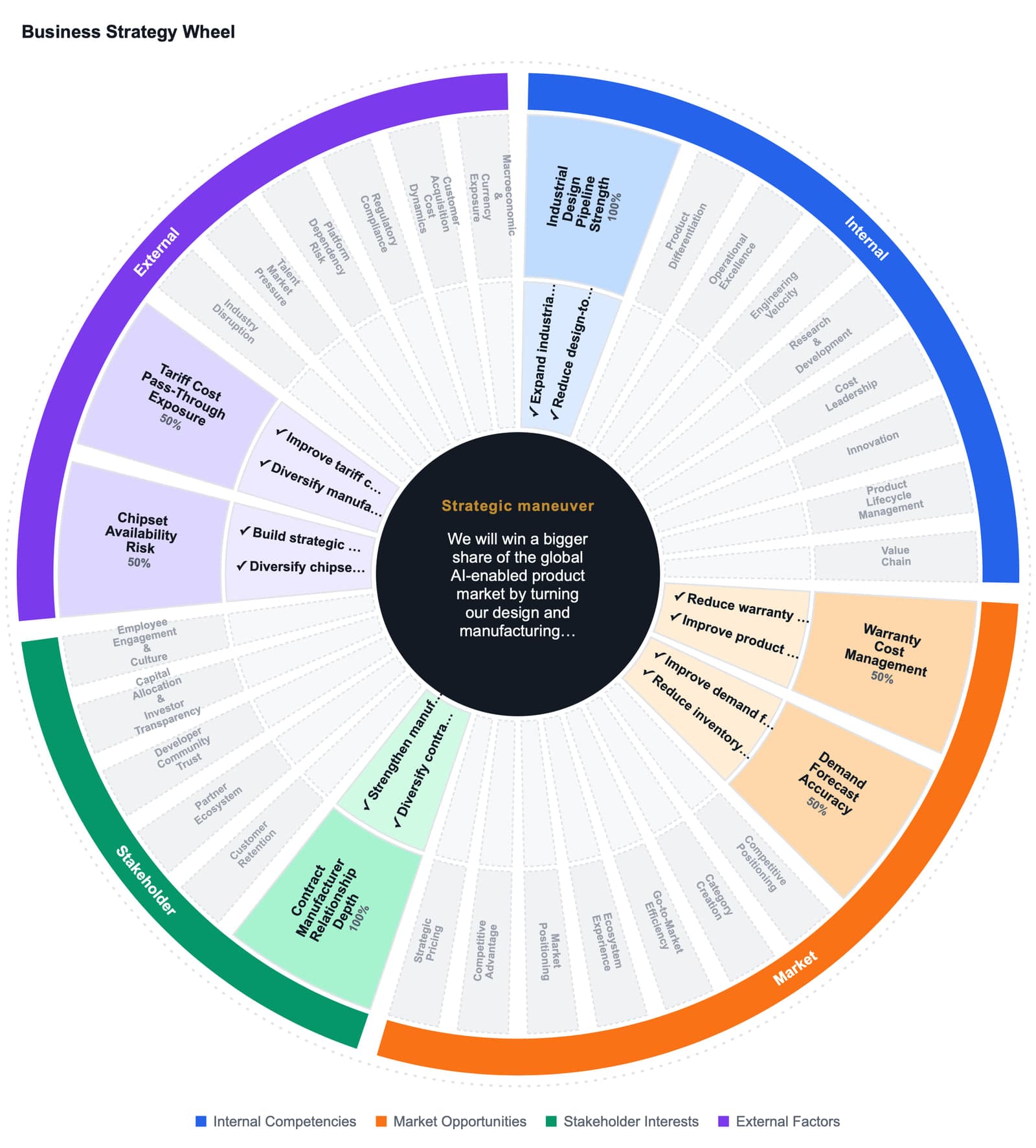
A business strategy is a chosen direction for how an organization will respond to the conditions it faces in order to achieve a desired outcome. It is not a polished document full of goals, initiatives and financial targets. It is a set of choices.
A useful strategy answers one question: given where we want to go and the conditions we face, what should we change?
That sounds simple. In practice it is hard, because organizations face competing priorities, limited resources, market uncertainty, stakeholder expectations and capabilities that cannot change overnight.
This guide walks through a practical, decision-first approach in ten steps. It is the approach behind the Strategic Decision Model, which StrategySOS turns into a working system. You can read how the model works on the methodology page.
Key takeaways
- Treat strategy as a decision before you treat it as a document.
- Start with the outcome you want, then examine the conditions shaping your choices.
- Identify what you can actually change, evaluate the options on impact, feasibility, risk and cost, and choose.
- Choosing means some options are not pursued. If everything makes the cut, nothing was prioritized.
- Connect the choice to every level of the organization, stress-test it, and only then plan the work.
The ten steps at a glance
- Define the outcome. What are we trying to achieve?
- Examine the drivers. Which internal, market, stakeholder and external forces shape the decision?
- Identify the Limitations. Which real conditions narrow or influence our choices?
- Identify the Parameters of Change. What can we actually change or influence?
- Evaluate the alternatives. Which changes offer the best combination of impact, feasibility, risk and cost?
- Make the strategic choice. Which changes are we actually going to pursue?
- State the strategy. Can we express the chosen direction clearly?
- Align the organization. Which business and functional strategies need to change because of this decision?
- Stress-test it. What happens if our assumptions, competitors or external conditions change?
- Plan the work. Who needs to do what, with what objectives, measures and ownership?
The rest of this guide explains each step.
What is a business strategy?
A business strategy is different from a goal, an initiative or an ambition.
"Grow revenue by 30%" is an objective.
"Enter three new markets" is an initiative.
"Become the market leader" is an ambition.
None of these, by themselves, explains what the organization has decided to change and why that change should produce the desired outcome. Strategy sits underneath those decisions.
A useful strategy should help leadership answer:
- What are we trying to achieve?
- What conditions are shaping our choices?
- What can we actually influence?
- Which changes are worth pursuing?
- Which changes should we not pursue?
- Why did we choose this direction over the alternatives?
- How does that direction affect the rest of the organization?
That is why strategy should be treated as a decision before it is treated as a document.
Start with the decision, not the document
One of the easiest ways to make strategy ineffective is to start by asking, "What should our strategy document contain?" That puts the artifact before the thinking.
A better starting point is: "What strategic decision do we need to make?"
Perhaps you need to decide whether to:
- enter a new market
- reposition the business
- accelerate growth
- defend margins
- invest in a new capability
- respond to a competitor
- adopt AI
- consolidate products
- change your customer focus
- transform the operating model
The strategic task determines what you need to examine. Once the decision is clear, the rest of the process becomes much more useful.
Step 1: Define the outcome you want
Before evaluating strategic choices, define the outcome the strategy is supposed to achieve. Be specific enough that the leadership team can recognize whether a proposed direction actually contributes to it.
A useful outcome:
Increase profitable growth in the North American mid-market while maintaining our existing enterprise customer base.
A less useful one:
Become a leading company in our industry.
The second statement may be inspirational, but it gives you little guidance when you have to choose between competing investments.
Your desired outcome becomes the test for everything that follows. If a proposed change does not meaningfully contribute to it, ask why it belongs in the strategy.
Step 2: Identify what is shaping your choices
Before deciding what to change, look at the forces shaping the decision. A practical way to do this is through four strategic lenses, which this approach calls Drivers.
Internal Competencies
What can the organization actually do?
Consider capabilities, resources, technology, talent, operating strengths, weaknesses and organizational constraints. A market opportunity may look attractive, but if the organization cannot realistically serve it, that matters.
Market Opportunities
Where is there potential for growth, differentiation or competitive advantage?
This includes customer demand, market shifts, whitespace, emerging categories and changes in competitive behavior. An opportunity matters strategically when the organization has a credible way to act on it.
Stakeholder Interests
Who has an interest in the outcome, and what do they need or expect?
Customers, employees, investors, partners, regulators and other stakeholders can influence what is strategically possible. A strategy that creates value for one stakeholder while making another critical relationship untenable may not be viable.
External Factors
What outside forces could shape the available choices?
These might include:
- regulation
- technology
- economic conditions
- geopolitical developments
- demographic changes
- industry shifts
- competitive moves
The purpose is not to produce an enormous environmental scan. It is to understand the conditions that matter to the decision you are trying to make.
Step 3: Identify the Limitations you have to work with
This is where strategy becomes more grounded. Every organization operates under conditions that shape its choices. Call these Limitations.
A Limitation is a real condition that shapes or narrows the strategic options available to you. It does not necessarily mean something is impossible. It might make an option:
- more expensive
- riskier
- slower
- harder to execute
- less attractive
- more urgent
- more dependent on another change
Consider a company trying to expand internationally. Its Limitations might include:
- limited local distribution
- weak brand recognition
- regulatory requirements
- insufficient sales coverage
- limited implementation capacity
- an existing customer base concentrated in another region
Simply listing these conditions is not strategy. The important question is: what do these conditions mean for the choices we can make? That moves the discussion from description toward decision-making.
Step 4: Define what you can actually change
Once you understand the conditions, identify the changes available to the organization. These are Parameters of Change.
A Parameter is a specific thing the organization can change or influence in response to a Limitation.
For example, take the Limitation limited distribution in a target market. Possible Parameters might include:
- Build a direct sales capability.
- Establish strategic channel partnerships.
- Acquire a local distributor.
- Narrow the initial market focus to a segment that can be served directly.
- Launch through an existing strategic partner.
Now the strategic conversation becomes much more concrete. Instead of asking, "How should we grow internationally?" you can ask, "Which of these changes gives us the best combination of impact, feasibility, risk and cost?" That is a much better strategic question.
Step 5: Evaluate your strategic options
Not every attractive idea deserves to become a strategic priority. Evaluate the available Parameters against four factors:
| Factor | The question it answers |
|---|---|
| Impact | How much could this change contribute to the desired outcome? |
| Feasibility | Can the organization realistically make this change? |
| Risk | What could go wrong if you pursue it? |
| Cost | What resources will the change require? |
These factors force discipline into strategy. An option with enormous potential but almost no feasibility may not be the right choice. An option that is extremely feasible but has little impact may not deserve strategic priority. An option with high impact and high feasibility may be much more compelling.
The point is not to pretend that a score can make a strategic decision for you. The point is to make the reasoning visible, so you can see why one option is favored over another.
Step 6: Choose the changes that matter most
This is the point where strategy actually happens. You have examined the conditions, identified what you can change, and evaluated the alternatives. Now leadership has to choose.
That means some options will be selected and others will not. Strategy is not the collection of everything the organization would like to do. If every initiative makes it into the strategy, there has been no meaningful prioritization.
A strong process makes the trade-offs visible. It should be possible to say:
"We chose this because it addresses the most important conditions affecting our desired outcome, and we believe it is more viable than the alternatives."
That is a strategic decision.
Step 7: Turn the choice into a Strategy Statement
Once the choices are clear, express the chosen direction in a concise Strategy Statement. It should reflect the changes the organization has decided to pursue. It should not simply repeat the objective; it should capture the direction created by the choices.
For example:
Focus international expansion on two high-potential markets, using strategic channel partnerships to overcome distribution constraints while building targeted internal capability over time.
The statement gives leadership and the organization a common reference point. It can then be challenged:
- Is it clear?
- Does it reflect the actual choices?
- Does it address the most important conditions?
- Does it describe a direction rather than a collection of disconnected initiatives?
If the answer is no, go back to the choices. Do not simply rewrite the sentence.
Step 8: Connect business strategy to functional strategy
A business strategy does not become real because the CEO and leadership team agree with it. The organization has to translate that direction into the functions that will create the change. Depending on the business, that might involve:
- Marketing
- Product
- Sales
- Brand
- Finance
- Operations
- Technology
- Human Resources
- Customer Success
- Supply Chain
- Legal
Not every function needs its own strategy. But functions with a significant strategic role should understand:
- What the business is trying to achieve.
- Which conditions matter to the business strategy.
- What needs to change within the function.
- How its strategic choices connect to the level above.
This is where strategic alignment matters. Corporate Strategy should inform Business Strategy. Business Strategy should inform Functional Strategy. Functional plans should then carry those choices into execution.
Without that connection, an organization can have a strong business strategy and still end up with departments pursuing conflicting priorities.
Step 9: Stress-test the strategy
A strategy is a hypothesis about what the organization should change. It should be challenged before significant resources are committed. Ask:
- What happens if the market changes?
- What happens if a major competitor responds?
- Which assumptions does this strategy depend on?
- What if an important capability takes longer to build?
- Which parts of the strategy are robust across different scenarios?
- Which choices become dangerous under a different future?
Competitive analysis can reveal moves that change the attractiveness of your options. Scenario analysis can reveal choices that work under one future but fail under another. An independent strategic perspective can expose assumptions the original team has taken for granted.
The objective is not to have AI or another analytical tool make the decision. It is to make the decision harder to break.
Step 10: Turn strategy into planning and execution
Strategy should eventually lead somewhere. Once the direction is established, it needs to inform:
- functional plans
- objectives
- OKRs
- owners
- measures
- initiatives
- assumptions
- review cycles
This is where planning belongs. Planning answers questions such as: who does what, by when, with what resources, and how will we measure progress? Those questions matter, but they come after the strategic choice.
A plan without a strategy can be very efficient at doing the wrong things. Strategy should determine what deserves to be planned.
What makes a business strategy defensible?
A defensible strategy is not necessarily one that everyone agrees with. It is one where the reasoning can be examined. You should be able to trace the strategy back through the logic that produced it:
Desired Outcome → Drivers → Limitations → Parameters of Change → Evaluation → Strategic Choice → Strategy Statement → Functional Alignment → Planning
That traceability lets leadership challenge the assumptions without starting the entire process again. It also makes the strategy easier to communicate. Instead of saying, "This is our strategy because leadership decided it," you can explain: these are the conditions we believe matter, these are the changes available to us, these are the choices we made, and this is why we selected them.
That is a strategy people can challenge, understand and defend.
Putting this into practice with StrategySOS
StrategySOS is built around exactly this sequence. It turns the framework from something you describe on a whiteboard into something you can work through, score, align and revisit. The methodology page explains the model in detail.
| Step | How it works in StrategySOS |
|---|---|
| 1. Define the outcome | A required Desired Outcome for each level of strategy |
| 2–4. Drivers, Limitations, Parameters | The four Drivers, with starter Limitations and Parameters for your industry so you never begin from a blank page |
| 5. Evaluate | Each Parameter is scored on impact, feasibility, risk and cost, with a criteria profile that matches your risk appetite |
| 6–7. Choose and state | Ranked options you check or uncheck, then a generated Strategy Statement you edit and lock |
| 8. Align | A Strategic Alignment View that links each level to the one above, plus guidance on which functions deserve their own strategy |
| 9. Stress-test | Competitive Analysis, Scenario Planning, an independent Strategy Twin and an Assumption Registry |
| 10. Plan | Planning Station for functional plans, and Monitoring Station for OKRs and owners |
AI assists with analysis and drafting throughout, but every suggestion is a draft you accept, edit or reject. The decision stays with you.
Frequently asked questions
What are the steps to build a business strategy?
Define the outcome you want, examine the internal, market, stakeholder and external forces shaping the decision, identify your Limitations, identify the changes you can make, evaluate the options on impact, feasibility, risk and cost, choose, state the strategy, align the organization, stress-test it, and then plan the work.
What is the first step in building a business strategy?
Define the desired outcome and the strategic decision the organization needs to make. This gives the rest of the process a clear purpose.
What should a business strategy include?
It should explain the desired outcome, the important conditions shaping the decision, the changes the organization can make, the strategic choices it has selected, and the direction those choices create.
What is the difference between strategy and a strategic plan?
Strategy is the choice of direction and what the organization intends to change. A strategic plan translates that direction into objectives, initiatives, ownership, timing and measures.
Do small businesses need a formal business strategy?
Yes, although the process does not need to be complicated. Smaller organizations have fewer resources, which makes prioritization even more important. The purpose of strategy is to decide where limited resources should be concentrated.
Should a business strategy use a framework?
A framework can make strategic thinking more structured and reduce the risk of overlooking important factors. But a framework is not the strategy itself. The value comes from the choices made using it.
What is the Strategic Decision Model?
The Strategic Decision Model is a way of building strategy as a decision. It moves from a desired outcome, through four Drivers, the Limitations within them and the Parameters of Change available, to a Strategy Statement. StrategySOS is the application built around it. See the methodology page for details.
Can AI build a business strategy?
AI can help analyze information, generate alternatives, identify patterns, challenge assumptions and stress-test strategic choices. But the strategic decision still belongs to the strategist or leadership team. AI can help you think through the decision; it should not quietly make the decision for you.
The real purpose of strategy
The goal of strategy is not to create the most impressive strategy document. It is to make a better decision about what the organization should change.
That decision becomes much stronger when the reasoning behind it is visible. Strategy is a decision about what to change. Once that decision is clear, planning and execution have something meaningful to follow.