How to Use AI to Stress-Test Your Business Strategy
The best use of AI in strategy isn't asking what strategy to have. It is asking what you might be missing. Here is a practical way to use AI to challenge assumptions, competitors and scenarios, with the strategist still deciding.
Yes, AI can stress-test a business strategy, and it is one of the best uses of AI in strategy. The most useful question to ask is not "What strategy should we have?" It is "What might we be missing?" Used this way, AI can surface assumptions, analyze competitive moves, explore scenarios, compare alternatives and flag contradictions. But there is a boundary: AI should challenge the strategy. It should not quietly become the strategist.
AI is particularly useful when it is used to challenge a strategy from different perspectives. The rest of this guide shows how, and where the boundary sits. (For the broader question of what AI should and shouldn't decide, see Should AI Create Your Business Strategy?.)
Key takeaways
- Ask AI "What might we be missing?", not "What should our strategy be?"
- Start with a real strategic choice. AI cannot meaningfully stress-test a strategy that doesn't exist.
- Test five things: assumptions, competitive response, alternatives, scenarios and internal contradictions.
- Treat the output as questions and evidence to examine, not automatic decisions.
- AI proposes. The strategist decides.
Start with a real strategy
AI cannot meaningfully stress-test a strategy that does not exist. Start with an actual strategic choice. For example:
We will concentrate our resources on becoming the leading provider for mid-market healthcare organizations rather than expanding across multiple industries.
Now there is something to challenge. AI can ask:
- Why this segment?
- Is the market large enough?
- What capabilities are missing?
- How might incumbents respond?
- What assumptions are most fragile?
- What happens if the segment becomes more competitive?
- What alternative strategy might be stronger?
The quality of the stress test depends on the quality of the strategy being tested.
Challenge the assumptions
Every strategy contains assumptions. Some are obvious. Others are hidden. For example:
Customers will pay a premium for our differentiated offering.
That statement may be central to the strategy. But how much evidence supports it? What happens if customers do not perceive the differentiation? What happens if a competitor offers a similar product at a lower price? What happens if the market changes?
AI can help surface these questions. The goal is not to make the strategy look weak. The goal is to discover where it is vulnerable before the market does.
Analyze competitors
A strategy exists in a competitive environment. Your company is not choosing in isolation. Competitors may:
- reduce prices
- launch similar products
- enter your target segment
- acquire capabilities
- change distribution
- increase marketing investment
- copy your positioning
AI can analyze public competitive signals and help identify where your strategy may be exposed. But public information is not perfect. A competitive signal can be reported, inferred or uncertain, which means competitive analysis should carry a level of confidence rather than pretending that every signal is fact.
Use an independent second opinion
One powerful application of AI is to build a completely separate strategic view. Give the AI the same high-level brief, but deliberately withhold your detailed Limitations and scoring. Then ask: if you approached this situation independently, what strategy would you construct?
This creates a useful comparison. It is not a critique. It is a second strategy. If the AI identifies an option you never considered, that does not mean the AI is right. It means you have discovered something worth examining. That is the value of an independent strategic perspective.
Explore different futures
A strategy that works in one future may fail in another. Scenario planning can help expose that. For example:
- Future 1: demand grows rapidly.
- Future 2: demand grows slowly and price pressure increases.
- Future 3: a major competitor enters the market.
Now test the strategy against each future. Some strategic moves may work in all three. Those are potentially robust choices. Others may only work in one scenario. Those may be contingent choices. Some may become valuable options or hedges. Others may become dead ends.
The objective is not to predict which future will happen. It is to understand how dependent the strategy is on a particular future.
Ask AI to argue against the strategy
One of the simplest stress tests is adversarial. Ask: assume this strategy fails. Explain why. Then ask: what would a strong competitor do to defeat it? Then: what assumption would have to be wrong for this strategy to fail?
These questions can produce uncomfortable answers. That is useful. A strategy that cannot survive reasonable challenge probably needs more work.
Use different executive perspectives
A strategy can look very different depending on who is examining it:
- A CEO may focus on strategic direction.
- A CFO may focus on capital and risk.
- A CMO may focus on market position and demand.
- A COO may focus on execution.
- A CTO may focus on technology capability.
These perspectives do not necessarily produce the same answer. That is exactly why they are valuable. The disagreement can reveal an unresolved strategic trade-off.
AI should propose, not decide
There is a critical difference between "AI says this is the right strategy" and "AI identifies this as an option worth considering." The first asks AI to own the decision. The second uses AI to improve human judgment. The second is much more useful.
AI can analyze, draft and challenge. The strategist decides what matters.
A practical AI stress test
Before committing to a strategy, ask AI to examine five things:
- Assumptions. What must be true for this strategy to work?
- Competitive response. How might competitors respond?
- Alternatives. What other strategic choices could address the same Limitations?
- Scenarios. How does the strategy perform under different plausible futures?
- Internal contradiction. Does anything in our assumptions, Limitations, priorities or plans conflict with the strategy?
The output should be questions and evidence to examine, not automatic strategic decisions.
The best AI strategy workflow
A useful sequence is:
Build → Score → Choose → Stress-test → Reconsider → Lock → Plan
AI enters primarily in the middle. It can make the strategic decision process richer without taking control of it. That is the distinction between using AI as a strategic assistant and asking AI to be the strategist.
Putting this into practice with StrategySOS
Several StrategySOS pages are designed for exactly this kind of challenge. They are optional, and each works from the strategy you have actually built:
- Strategy Twin builds its own strategy from the same starting brief, deliberately blind to your Limitations, Parameters and scores. It is a second opinion, not a critique. You compare it with yours and add the gaps you agree with.
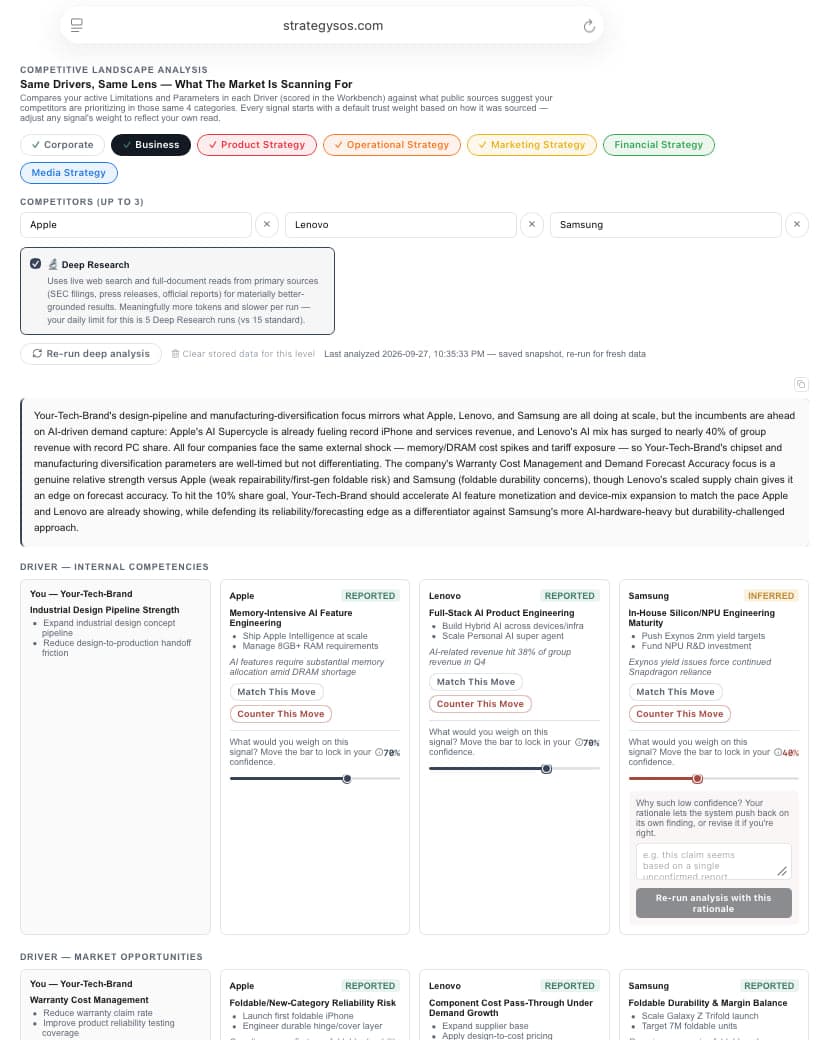
- Competitive Analysis compares your four Drivers with what public sources suggest competitors prioritize. Each signal is marked reported or inferred, with a trust weight you can adjust (70% and 40% by default). If you doubt a signal you can challenge it with your reason and the AI re-checks it. Match This Move and Counter This Move turn a competitor's action into a Limitation and Parameter of your own.
- Scenario Planning builds up to three plausible futures grounded in your Competitive Analysis and tests how your Limitations and Parameters hold up. Every move is classified as Robust, No-Regrets, Contingent, Option, Hedge or Dead-End.
- Agentic C-Suite reads your scored data through eight executive lenses (CEO, CFO, CMO, COO, CTO, CDO, CPO and CHRO), plus a view for each active function.
- AI Strategic Analyst reads your scoring, assumptions, locked Strategy Statement, competitive analysis and scenarios. You can tell it what you are least confident about, and it proposes new Parameters, re-evaluations, emerging risks and stale or conflicting assumptions. It proposes and never decides.
- Scenario Analysis checks coherence across every Strategy Statement you have built, flagging exposures and gaps between levels.
- Assumption Registry keeps every assumption in one place, with its confidence, evidence and review date, so a stress test has something specific to examine.
Competitive Analysis, Strategy Twin, Scenario Planning and Scenario Analysis also offer an optional Deep Research mode, which researches more thoroughly, uses more of your allowance and has a lower daily limit. AI features are part of a subscription, and every suggestion is a draft you accept, edit or reject. The methodology page explains the Strategic Decision Model, and Why StrategySOS explains why it exists.
Frequently asked questions
Can AI stress-test a business strategy?
Yes. AI can help surface hidden assumptions, analyze competitive responses, explore scenarios, compare alternatives and flag contradictions. It works best as a challenger, not as the author of the strategy.
What should you ask AI when stress-testing a strategy?
Ask what assumptions must be true, how a strong competitor could respond, what alternative choices could address the same Limitations, how the strategy performs in different futures, and whether anything in your own priorities or plans contradicts it.
How does scenario planning help stress-test a strategy?
It shows how dependent a strategy is on one particular future. Moves that hold up in every scenario are robust. Moves that only work in one are contingent, and some become options, hedges or dead ends.
What is an independent second opinion in strategy?
It is a separate strategy built from the same high-level brief but without your detailed Limitations and scores. It isn't a critique. It is a comparison point that can reveal options you hadn't considered.
Should AI make the final strategic decision?
No. AI can analyze, draft and challenge, but the strategist or leadership team decides what matters and what the organization is willing to change.
Does AI need a real strategy to test?
Yes. A stress test is only as good as the strategy being tested, so start from an actual strategic choice rather than asking AI to invent one.