How to Evaluate Strategic Options: Impact, Feasibility, Risk and Cost
Strategic options are easy to generate and hard to choose between. This guide shows how to evaluate them on impact, feasibility, risk and cost, and why a score is evidence, not an instruction.
To evaluate strategic options, judge each possible change on four questions: how much impact it could have, whether the organization can realistically do it, what could go wrong, and what it will cost. Those four criteria, impact, feasibility, risk and cost, don't turn strategy into mathematics. They make the trade-offs visible, so the choice you make is one you can explain and defend.
Strategic options are easy to generate. Choosing between them is harder. A leadership team can usually produce dozens of plausible moves:
- enter a new market
- launch a new product
- change pricing
- expand the sales team
- invest in brand
- build a new capability
- acquire a competitor
- form a partnership
- improve customer retention
- expand geographically
The problem is not generating options. The problem is deciding which ones deserve strategic commitment.
Key takeaways
- Evaluate each option on four questions: impact, feasibility, risk and cost.
- Start with the Limitation, not the idea. Ask which available change best addresses a real condition and moves you toward the outcome.
- A score makes judgment visible. It doesn't replace it. The strategist stays accountable for the choice.
- Check how sensitive the ranking is: an option that stays near the top under different assumptions is a more robust choice.
- Always ask what happens if we do nothing. Not choosing is also a strategic choice.
The four criteria at a glance
| Criterion | The question it asks |
|---|---|
| Impact | If this works, how much could it change our position? |
| Feasibility | Can we actually make this change? |
| Risk | What could go wrong if we pursue it? |
| Cost | What resources will it consume? |
Start with the Limitation, not the idea
One of the easiest ways to make strategic evaluation more disciplined is to begin with the problem or condition you are trying to address. Call it a Limitation: a real condition that shapes or narrows the choices available to an organization. For example:
Customer acquisition costs are increasing in our current channel.
That condition could lead to several possible changes:
- develop a partner channel
- increase retention
- enter a lower-cost customer segment
- improve conversion
- build organic demand
- change pricing
These are Parameters of Change. The strategic question is not "Which idea do we like?" It is: which available change best addresses the condition and moves us toward the desired outcome? (For the full process, see How to Build a Business Strategy: A Practical Step-by-Step Framework.)
Impact
Impact asks: if this works, how much could it change our position? High-impact options could materially affect growth, profitability, competitive position, customer value or organizational capability.
But high impact alone does not make an option strategically attractive. A major acquisition may have enormous potential impact. So might entering a new international market. Potential impact has to be considered alongside everything else.
Feasibility
Feasibility asks: can we actually make this change? Consider:
- capabilities
- people
- technology
- capital
- time
- organizational readiness
- access to customers
- operational complexity
A theoretically excellent strategy that an organization cannot execute is not a good strategy. Feasibility is therefore not an administrative consideration. It is strategic.
Risk
Risk asks: what could go wrong if we pursue this option? Risk can come from:
- market uncertainty
- competitive response
- technology
- regulation
- execution
- financial exposure
- customer reaction
- organizational complexity
A risky option is not automatically a bad option. A transformational strategy may deliberately accept more risk in exchange for greater potential impact. The important thing is to make that trade-off explicit.
Cost
Cost asks: what resources will this change consume? Cost is broader than money. It can include:
- people
- management attention
- time
- capital
- opportunity cost
- organizational disruption
A strategy can fail because the organization chose too many attractive options simultaneously.
Do not confuse score with judgment
Scoring does not eliminate judgment. It makes judgment visible. For example, one leadership team might prioritize high impact and accept greater risk because it is pursuing transformation. Another might prioritize feasibility and lower risk because it needs to protect cash. Neither approach is automatically correct. The strategic context determines the appropriate trade-off.
Compare the options, not just the winners
A useful evaluation process should also ask: how sensitive is our decision to the way we score the criteria? If an option remains near the top under different assumptions, it may be a relatively robust choice. If its ranking changes dramatically when risk or feasibility changes slightly, that tells you something important. The uncertainty itself becomes part of the strategic conversation.
What if the highest-scoring option is not the right one?
This is where strategic judgment matters. Suppose Option A scores highest but depends on an assumption you have very little confidence in. Option B scores slightly lower but is easier to reverse. The right decision may still be B.
A score is evidence. It is not an instruction. The strategist remains accountable for the choice.
A practical checklist for evaluating strategic options
For every meaningful option, ask:
- What Limitation does it address?
- What outcome could it influence?
- What is its potential impact?
- Can we realistically execute it?
- What could go wrong?
- What will it require?
- What assumptions does it depend on?
- What happens if we do nothing instead?
That last question is often neglected. Not choosing an option is also a strategic choice.
The goal is not the highest score
The goal is a decision you can defend. A strong strategic choice should allow the leadership team to explain:
We chose this because it addresses an important Limitation, has meaningful potential impact, is feasible for our organization, carries an acceptable level of risk and is worth the resources required.
That is much stronger than "we chose it because everyone liked the idea." Strategy is a choice about what to change. Evaluating options is how you make that choice more deliberate. (See also Strategy Is a Decision About What to Change.)
Putting this into practice with StrategySOS
StrategySOS builds this evaluation into the Workbench:
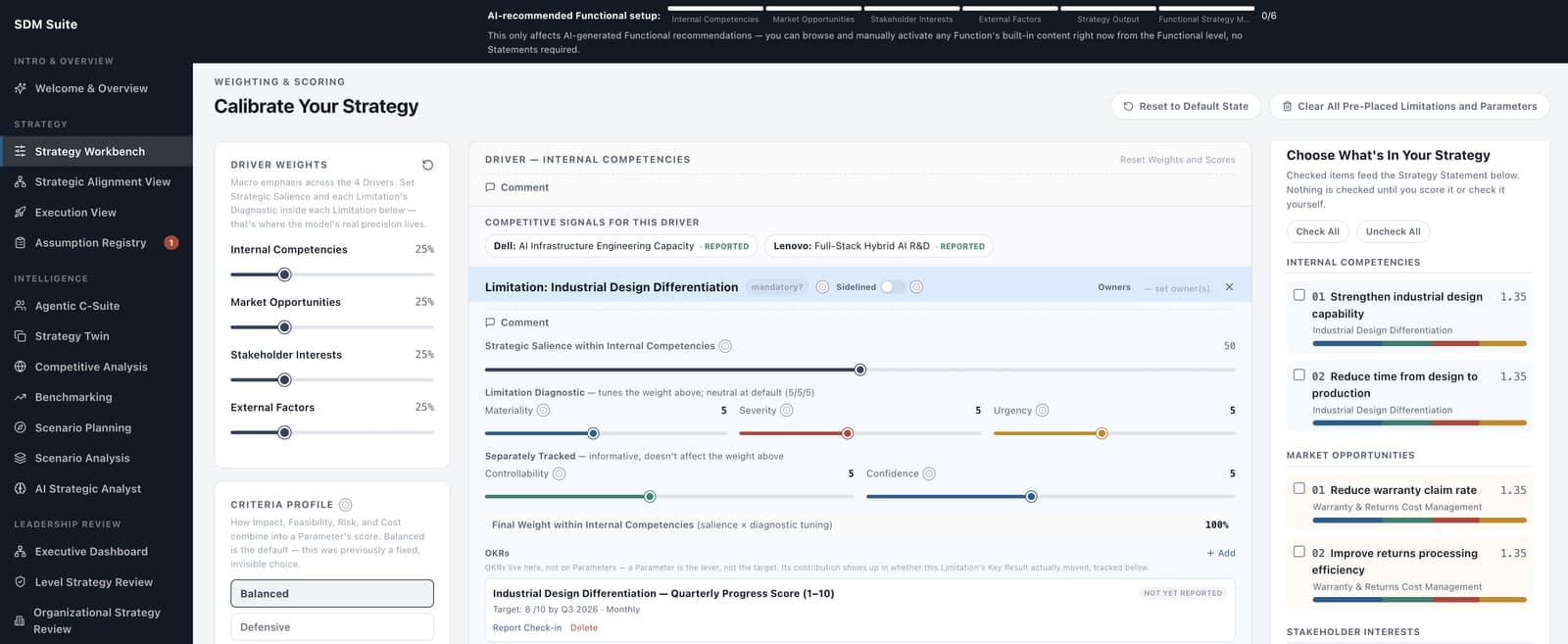
- Score each option on the four criteria. Every Parameter of Change is scored on Impact, Feasibility, Risk and Cost, from 1 to 10. A low Risk or Cost score counts in the option's favor. Scores start neutral, so nothing is pre-judged for you.
- Choose your appetite for risk. A Criteria Profile sets how the four criteria combine. Balanced is a general-purpose default. Defensive favors safe, feasible, low-cost bets. Transformational favors high impact even when the risk is higher.
- Test how sensitive the ranking is. Switch between the three profiles. If your top choice barely moves, it is robust; if it drops sharply, you have learned something about how much it depends on your appetite for risk.
- Check that an option actually resolves the Limitation. Each Parameter has a Resolution Strength, which says how strongly it addresses its Limitation. You can lower it for something attractive that doesn't fix the problem.
- Record the assumptions. An assumption can be attached to a Parameter and appears in the Assumption Registry, with a confidence level, an evidence rating and a review date.
- Stay in control of the decision. Options are ranked by score, but you decide which ones go into the Strategy Statement. The ranking never makes the choice for you.
The methodology page explains the Strategic Decision Model, and Why StrategySOS explains why it exists.
Frequently asked questions
How do you evaluate strategic options?
Evaluate each option on four criteria: impact (how much it could change your position), feasibility (whether you can realistically do it), risk (what could go wrong) and cost (what resources it needs). Start from the Limitation the option addresses, and make the trade-offs explicit.
What criteria should you use to compare strategic options?
Impact, feasibility, risk and cost are a practical core set. Each captures a different trade-off, so an option cannot look attractive on only one dimension.
Should you always choose the highest-scoring option?
No. A score is evidence, not an instruction. If the top option depends on a weak assumption, or a slightly lower-scoring option is easier to reverse, the better decision may be the second one. The strategist remains accountable.
How do you handle risk when comparing options?
A risky option is not automatically a bad one. A transformational strategy may deliberately accept more risk for more impact. What matters is making that trade-off explicit, so it is a choice and not an accident.
Why should you consider doing nothing?
Not choosing is also a strategic choice, with its own consequences. Comparing each option with the cost of doing nothing keeps the evaluation clear about what you would be giving up.
How is evaluating options different from prioritizing initiatives?
Prioritizing initiatives ranks activities. Evaluating strategic options compares possible changes against a Limitation and a desired outcome, before anything becomes an initiative. It is part of deciding what to change, which comes before planning.