Corporate vs. Business vs. Functional Strategy: What's the Difference?
Corporate, business and functional strategy are three levels of strategic choice. This article explains what each one decides, how the levels connect, and why not every function needs its own strategy.
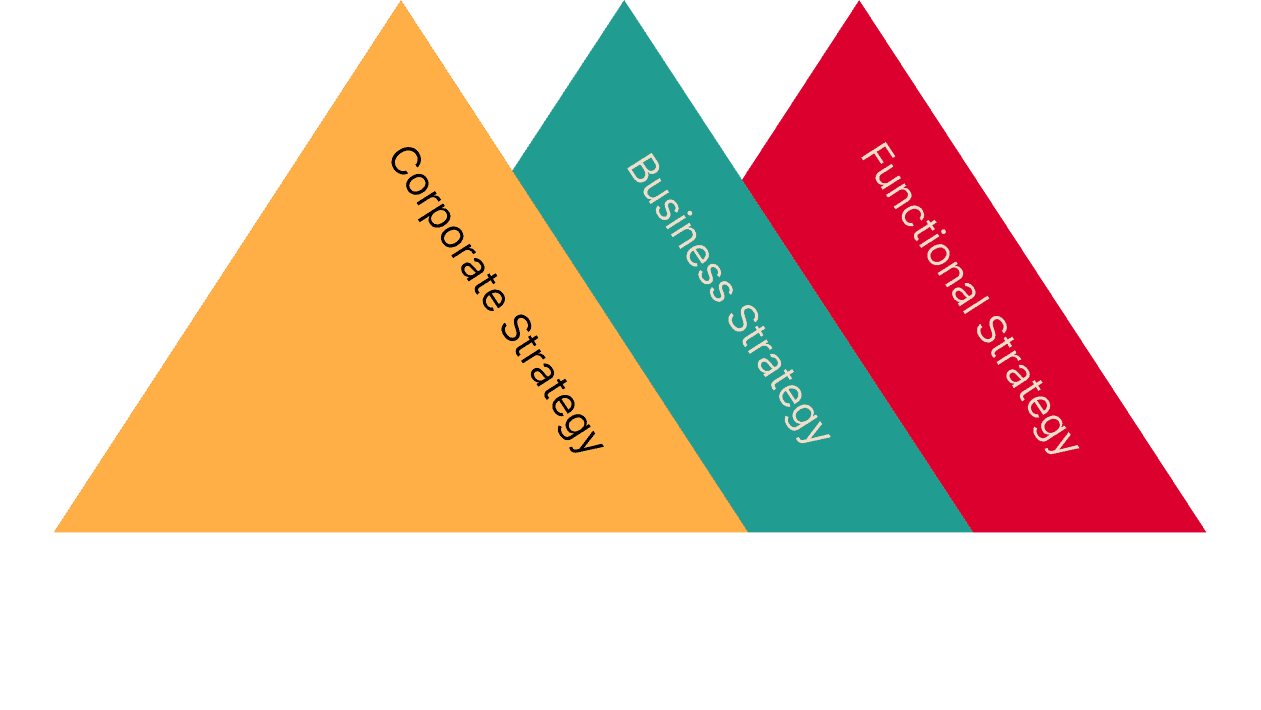
Corporate, business and functional strategy are three levels of strategic choice. Corporate strategy sets the direction for the organization as a whole. Business strategy decides how a business or market will compete. Functional strategy decides what a significant function needs to change to support that direction. They are not competing strategies. They are connected decisions, and the real challenge is keeping them connected.
One of the easiest ways for strategy to become confusing is to talk about "the strategy" as though an organization only has one. A company can have a corporate strategy. Each business can have its own. Marketing, Product, Operations, Finance and other functions may each need a functional strategy of their own.
The important question is not only what each level means. It is how they relate to one another. The same strategic reasoning can be applied at all three levels. The challenge is keeping the decisions connected.
Key takeaways
- Corporate, business and functional strategy are different levels of strategic choice, not three versions of one document.
- Each level answers a different question, but they should form a chain: Corporate → Business → Functional.
- Alignment is not copying. A functional strategy should look different from the business strategy because the function faces different decisions.
- Not every function needs its own strategy. A function earns one when it faces meaningful choices about what to change.
- Alignment should be visible, not just declared.
What are the three levels of strategy?
The three commonly used levels are:
- Corporate strategy
- Business strategy
- Functional strategy
They answer different strategic questions, but they should not operate as three unrelated planning exercises.
| Level | The question it answers | What it decides |
|---|---|---|
| Corporate | What direction should the organization take? | Where to compete, where to invest, which businesses to grow, maintain or exit |
| Business | How should this business compete and create value? | Target customers, market position, offering, pricing, channels, differentiation, business model |
| Functional | What does this function need to change to support that direction? | The changes a significant function makes, such as audience and positioning for Marketing or prioritization for Product |
The relationship can be summarized simply: Corporate → Business → Functional. The higher level provides context and direction for the level below. The lower level translates that direction into the changes its own area needs to make. That creates a chain of strategic decisions rather than a collection of disconnected plans.
What is corporate strategy?
Corporate strategy sets the direction for the organization as a whole. It is concerned with questions that affect the organization broadly, such as:
- Where should the organization compete?
- Which businesses or markets should it participate in?
- Where should it invest?
- Which capabilities should it build?
- Which businesses should it grow, maintain or exit?
- How should different parts of the organization contribute to the overall direction?
Corporate strategy is therefore not simply the CEO's list of priorities. It represents choices that affect the organization at the highest strategic level.
For a diversified organization, corporate strategy might involve increasing investment in one business while reducing exposure to another. For a single-business company, corporate strategy and business strategy may overlap considerably. The distinction matters less than the strategic level at which the decision is being made.
What is business strategy?
Business strategy determines the direction for a business, business unit or market. The central question becomes: how should this business compete and create value? That can involve choices around:
- target customers
- market position
- products and services
- pricing
- channels
- capabilities
- customer experience
- competitive differentiation
- geographic focus
- business model
A business strategy should not simply repeat the corporate strategy. It needs to make the strategic choices relevant to the specific business.
For example, corporate strategy might establish that a company will grow in financial services. The business strategy for its financial-services business then has to determine how that business will actually compete in that market. It might choose to focus on a particular customer segment, differentiate through digital experience, build a particular capability or change its distribution model.
The corporate decision establishes direction. The business decision makes that direction competitive and actionable within the business.
What is functional strategy?
Functional strategy determines what a function needs to change to contribute to the strategy above it. Functions can include:
- Marketing
- Product
- Brand
- Sales
- Operations
- Finance
- Technology
- Human Resources
- Customer Experience
- Supply Chain
- GTM
Not every function needs its own strategy in every situation. A function should have a distinct strategy when its choices are significant enough to require their own strategic direction. A functional strategy should not exist simply because an organization has a functional department. The question is: does this function need to make meaningful strategic choices of its own? If the answer is yes, it may warrant its own strategy.
An example: entering a new market
Consider a company that decides to enter a new geographic market.
- At the Corporate level, the organization may decide that international expansion is important to its growth.
- At the Business level, a particular business decides which market to enter, which customers to target and how it will compete.
- At the Functional level, different functions determine what they need to change to support that business strategy.
Marketing might need to change its positioning, channels and demand-generation approach. Product might need to adapt the offering to local requirements. Operations might need to establish a new delivery model. Finance might need to support a different pricing, investment or risk structure. Technology might need to address local infrastructure or integration requirements.
The functions are making their own strategic decisions. But they should not be inventing a completely separate direction. Their strategies should contribute to the business strategy.
Why can't every function just follow the corporate strategy?
Because the corporate strategy is usually too broad to answer the strategic questions facing every function. Suppose the corporate strategy is:
Grow through customer-led digital transformation.
That may be directionally useful. But what does it mean for Marketing? For Product? For Operations? For Finance? For Technology? Each function faces different conditions, Limitations and opportunities:
- Marketing may need to change how it acquires and retains customers.
- Product may need to change how it prioritizes features.
- Technology may need to change the architecture supporting digital experiences.
- Operations may need to change processes that create customer friction.
- Finance may need to change how investment decisions are evaluated.
The corporate strategy provides context. It does not eliminate the need for functional strategic choices.
The same strategic model can operate at every level
Although the questions differ, the basic strategic reasoning does not have to change. At each level, an organization can ask:
- What outcome are we trying to achieve?
- What is shaping our choices?
- What Limitations are narrowing our options?
- What can we change?
- Which changes should we choose?
This creates consistency without forcing every level to make identical decisions. The corporate, business and functional strategies can use the same underlying logic while dealing with different strategic problems. (The full process is set out in How to Build a Business Strategy: A Practical Step-by-Step Framework.)
Drivers provide a common lens
One way to maintain consistency is to examine strategy through the same four Drivers at every level:
- Internal Competencies: what can we actually do? This includes capabilities, resources, expertise, technology, assets and other internal strengths or weaknesses.
- Market Opportunities: where is there potential for growth, value creation or competitive advantage?
- Stakeholder Interests: what matters to customers, employees, investors, partners, regulators and other stakeholders?
- External Factors: what outside forces could shape the choices, such as technology, regulation, economic conditions, competitive developments or geopolitical factors?
Using common lenses does not mean the answers will be the same. In fact, they should often be different. The purpose is to make sure each level considers the relevant dimensions of the strategic decision.
Limitations are where the levels start to connect
A particularly useful way to connect strategies is through their Limitations. A Limitation is a real condition that shapes or narrows the choices available. For example, a corporate-level Limitation might be:
The organization has limited investment capacity across multiple growth priorities.
A business-level Limitation could then reflect a more specific consequence:
The business cannot simultaneously expand into three markets without diluting investment in its strongest segment.
A functional-level Limitation might be:
Marketing lacks localized customer data in the new market.
These are different Limitations, but they can be related. The higher-level Limitation provides context for the lower-level decision. The lower-level Limitation explains what that context means within a particular business or function. This is where strategic alignment becomes more than a slogan.
Alignment is not copying
Strategic alignment does not mean that every strategy should contain the same words. That would be superficial alignment. A strong functional strategy should often look different from the business strategy, because the function faces different decisions.
Imagine a business strategy that says:
Win the premium segment through a differentiated customer experience.
Marketing might choose to change its audience strategy and positioning. Product might choose to change the product experience. Operations might choose to change service delivery. Finance might change the way customer economics are evaluated. The wording is different. The choices are different. But they can still point in the same direction.
Alignment is about connected choices, not identical language.
What happens when the levels are not aligned?
The symptoms are familiar. A company says one thing at the corporate level while its functions optimize for something else. For example:
- Corporate: become the premium provider.
- Business: win through superior customer experience.
- Marketing: maximize lead volume at the lowest possible cost.
- Product: prioritize the largest number of features.
- Operations: minimize service costs regardless of customer impact.
Every function may be achieving its own targets. The organization can still be moving in different directions. This is one of the most important reasons strategy needs to be connected across levels. A function can be efficient and still be strategically misaligned.
Alignment works in both directions
There is an important nuance here. Strategy does not always flow neatly from the top down. A functional team may uncover a Limitation that leadership had not considered. Product may discover a technology constraint. Marketing may identify a fundamental change in customer behavior. Operations may uncover a delivery constraint that makes the business strategy difficult to execute.
These discoveries can challenge the strategy above them. So strategic alignment should not mean that lower levels simply accept whatever comes from above. The relationship should allow information and reasoning to move upward as well as direction downward. That is how strategy gets refined.
Not every function needs its own strategy
This is worth emphasizing because organizations can easily over-engineer strategy. If every department is required to produce a separate strategic document every year, the organization may end up with dozens of strategies and very little strategic clarity.
A function should earn its own strategy. The question is whether it faces meaningful choices about what needs to change. For one organization, Marketing may require a substantial strategy because customer acquisition and positioning are central to the business model. For another, the marketing function may primarily execute an established direction and need a functional plan rather than a separate strategy.
The distinction is useful: a plan organizes activity. A strategy makes a consequential choice about direction. Not every activity needs its own strategic layer.
Functional strategy is not functional planning
This distinction is particularly important. A Marketing Plan might contain:
- campaigns
- content
- events
- media
- budgets
- timelines
- owners
- KPIs
A Marketing Strategy should first determine what Marketing needs to change and why. For example:
Shift from broad category demand generation toward concentrated account-based growth in the highest-value enterprise segment.
That strategic choice can then inform the Marketing Plan. The plan answers how the choice will be executed. Strategy answers what Marketing has decided to change. The same distinction applies to Product, Operations, Finance, HR and other functions. (For more on the difference, see Strategy Is a Decision About What to Change.)
The three levels form a chain
The simplest way to visualize the relationship is:
Corporate strategy → Business strategy → Functional strategy → Functional plans and execution
Each level answers a more specific version of the strategic question:
- Corporate asks: what direction should the organization take?
- Business asks: what direction should this business take within that organization?
- Functional asks: what does this function need to change to support that direction?
- Planning then asks: how will we execute that change?
That sequence matters. If you jump directly from corporate ambition to functional activities, the strategic reasoning in the middle can disappear.
A practical test for strategic alignment
Take any functional strategy and ask:
- What business-level outcome is this supporting?
- What business-level conditions make this change necessary?
- Which business Limitation does this functional choice address?
- What is the function actually changing?
- Why is this the right functional choice?
- What would happen if the business strategy changed?
If those questions cannot be answered, the functional strategy may be operating independently from the business strategy. That does not automatically mean it is wrong. It means the connection needs to be examined.
Putting this into practice with StrategySOS
StrategySOS applies the same decision model at all three levels. In the Workbench you switch between Corporate, Business and Functional, and each level has its own Desired Outcome, Drivers, Limitations, Parameters of Change and Strategy Statement. Three things then help keep the levels connected:
- Which functions need their own strategy. Functional Strategy Mapping reads your Corporate or Business Strategy Statement and recommends which functions are significant enough to need their own strategy ("Needs Strategy") and which mainly carry out the direction ("Contribution only"). You can change any recommendation.
- How the levels connect. Each Limitation can be linked to a Limitation at the level above. The Strategic Alignment View shows every level's Strategy Statement and how many Limitations are linked upward. StrategySOS can suggest links, and you accept them or choose a different one. A Parameter whose Limitation isn't linked upward is scored with a discount, so missing alignment shows up in the ranking and not only on a slide.
- From strategy to plan. Planning Station turns each active Functional Strategy into a working plan that starts from the strategy above it.
The methodology page explains the Strategic Decision Model, and Why StrategySOS explains why it exists.
Frequently asked questions
What are the three levels of strategy?
The three levels are Corporate, Business and Functional. Corporate strategy sets direction for the organization, Business strategy sets direction for a business or market, and Functional strategy determines what a significant function needs to change to support that direction.
What is the difference between corporate and business strategy?
Corporate strategy addresses the organization as a whole. Business strategy addresses how a particular business, business unit or market should compete and create value.
What is the difference between business and functional strategy?
Business strategy determines the direction of a business or market. Functional strategy determines what a function such as Marketing, Product, Operations or Finance needs to change to contribute to that direction.
Does every function need a functional strategy?
No. A function needs its own strategy when it faces significant strategic choices about what it needs to change. Some functions may only require a functional plan for executing an established direction.
How does functional strategy support business strategy?
Functional strategy translates the business direction into meaningful choices for the function. It should identify what the function needs to change and connect those choices to the conditions and Limitations shaping the business strategy.
Should corporate, business and functional strategies be identical?
No. They should be connected, not identical. Each level faces different strategic decisions and therefore may have different choices and Strategy Statements.
Can functional strategy influence business strategy?
Yes. Strategic alignment should not be purely top-down. Functional teams can identify Limitations, opportunities or changes that challenge assumptions at the business or corporate level.
What is strategic alignment?
Strategic alignment is the connection between strategic choices at different organizational levels, so that Business and Functional strategies remain connected to the direction established above them.
Corporate, business and functional strategy are different by design
The three levels should not be treated as three versions of the same document. They exist because organizations make different kinds of strategic choices at different levels. Corporate strategy decides the overall direction. Business strategy decides how a business or market will pursue that direction. Functional strategy decides what a significant function needs to change to contribute.
The objective is not to make them identical. It is to make them connected. That connection is what allows an organization to move from strategic intent to coordinated choices. It is also where many organizations struggle, because once multiple business units and functions start making their own strategic decisions, simply telling everyone to "align" is not enough. The organization needs a way to see how those decisions connect.
That is the subject of How to Align Functional Strategy With Business Strategy.