How to Build a Startup Strategy Without Hiring a Strategy Consultant
Startups don't have a strategy problem. They have a choice problem. This guide gives founders a ten-step, decision-first way to build a serious strategy in-house, and explains when outside help is worth it.
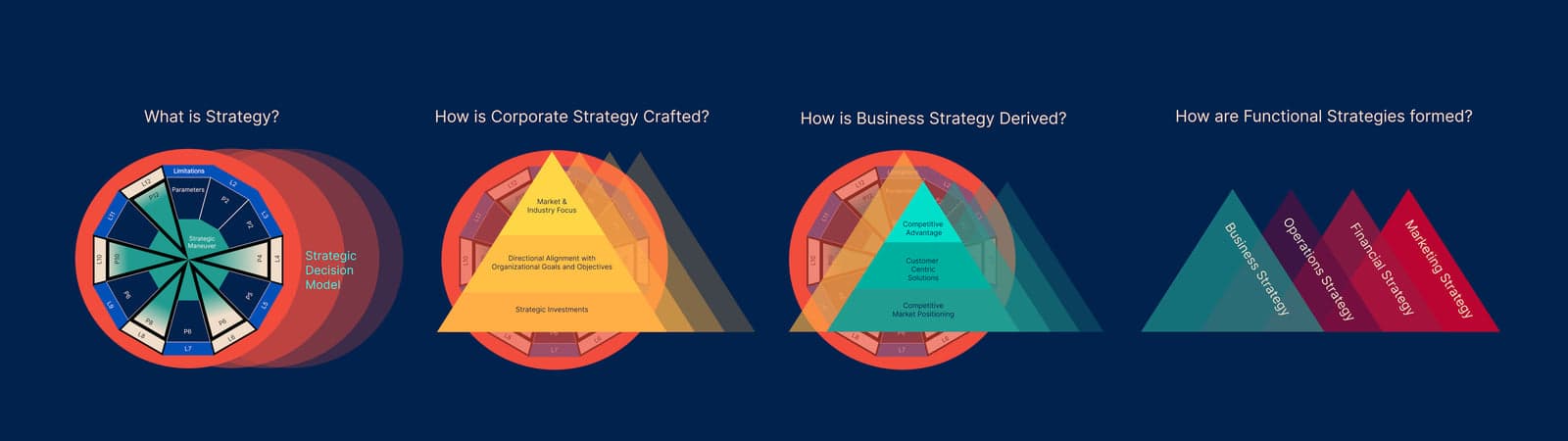
A startup can build a serious strategy itself, without a consultant, a 100-page deck or months of workshops. What it needs is a disciplined way to make a handful of important choices explicit: where it is trying to go, what is shaping its choices, what is limiting it, what it can actually change, and which of those changes are worth making.
Startups often face a strange choice when it comes to strategy. Either strategy stays largely in the founder's head, or the company brings in outside consultants to formalize it. There is a middle ground. The objective is not to make a startup look like a large corporation. It is to help a small organization make better choices with limited resources.
This guide applies the same ten-step process described in How to Build a Business Strategy: A Practical Step-by-Step Framework to the constraints a startup actually faces.
Key takeaways
- A startup's problem is rarely a lack of ideas. It is deciding which changes matter most.
- You don't need a consulting engagement to think strategically. You need a structured decision process instead of an informal conversation.
- A startup's Limitations, such as runway, team size and brand awareness, shape which options are realistic.
- Strategy means choosing what not to pursue. If everything is a priority, nothing is.
- Outside expertise is valuable for specific situations. Don't outsource strategic thinking simply because it feels difficult.
The ten steps at a glance
- Define the outcome. What are we trying to achieve?
- Understand the Drivers. What internal, market, stakeholder and external factors shape our choices?
- Identify the Limitations. What conditions constrain what we can realistically do?
- Define the Parameters of Change. What can we actually influence or change?
- Evaluate the options. Which changes have the strongest combination of impact, feasibility, risk and cost?
- Make the strategic choice. What will we change, and what will we deliberately not pursue?
- State the strategy. Can we express the direction clearly enough that someone else can understand the choice?
- Align the functions. What does each strategically involved function need to change?
- Stress-test the decision. Which assumptions, competitors or scenarios could undermine it?
- Plan the execution. What objectives, initiatives, owners and measures will turn the strategy into action?
You do not need a strategy department. You do need the discipline to make the choices explicit.
Startups don't have a strategy problem. They have a choice problem.
Early-stage companies usually have more possible directions than they have resources. They could:
- build more product features
- enter another market
- target a different customer segment
- change their pricing
- invest in brand
- expand the sales team
- pursue partnerships
- improve customer retention
- raise more capital
- change their business model
- expand geographically
The problem is rarely a lack of ideas. The problem is deciding which changes matter most. A list of possible initiatives is not a strategy. Neither is a set of goals, a vision statement, or a three-year financial forecast. A strategy requires choices about what the organization should change. (More on this in Strategy Is a Decision About What to Change.) For a startup this matters even more, because every strategic choice consumes scarce resources.
You don't need a consulting engagement to think strategically
Strategy consulting can be valuable. There are situations where outside expertise, market research, financial analysis, industry access or an independent perspective can justify an engagement. But not every strategic question requires one. A startup may simply need to answer questions such as:
- Should we focus on one customer segment or continue serving several?
- Should we expand the product or improve the core product?
- Should we enter a new market now or deepen our position in the current one?
- Should we compete on price, differentiation, speed, specialization or something else?
- Should we hire ahead of demand or preserve cash?
- Should we build internally or partner?
- What should we stop doing?
These are strategic decisions, and you can approach them rigorously without outsourcing the thinking. The key is to replace an informal conversation with a structured decision process.
Step 1: Define the outcome
Start with what you are trying to achieve. Not every startup needs a grand five-year vision. A useful strategic outcome can be much more specific. For example:
Establish a defensible position in the North American mid-market within three years.
Or:
Reach sustainable profitability without raising another round.
Or:
Become the leading workflow platform for independent healthcare clinics in Canada.
The outcome gives the strategy something to solve for. Without it, every attractive opportunity can start to look like a strategic priority.
Step 2: Understand what is shaping your choices
Before deciding what to change, understand the conditions surrounding the decision. A practical way to do this is to look through four Drivers:
- Internal Competencies: what can the company actually do well?
- Market Opportunities: where is there an attractive opportunity to create value?
- Stakeholder Interests: what matters to customers, employees, investors, partners, founders and other important stakeholders?
- External Factors: what outside forces could affect the choices available to the company?
These four perspectives prevent strategy from becoming an inside-out exercise. A startup may believe it has an excellent product, for example, but that does not automatically mean the product is the most important strategic lever. The market, customers, capital environment, competitors and organizational capabilities all matter.
Step 3: Identify the Limitations you actually have
This is where startup strategy becomes particularly important. Startups operate under constraints. You may have:
- limited cash
- limited runway
- a small team
- low brand awareness
- founder dependency
- limited distribution
- immature technology
- regulatory constraints
- customer concentration
- an unproven business model
- limited access to capital
These conditions are Limitations. They are not simply problems to list in a SWOT analysis. They shape the choices you can realistically make. A startup with six months of runway cannot evaluate strategic options in exactly the same way as a company with three years of cash. A company with ten employees cannot execute a strategy that assumes the capabilities of a company with 500.
The question is not simply "What would be a great strategy?" It is: given our actual Limitations, what strategic changes are available to us?
Step 4: Identify what you can actually change
This is one of the most important steps. Call these Parameters of Change. A Limitation might be:
We have very limited brand awareness outside our existing customer segment.
Possible changes might include:
- focus marketing on a narrower high-value segment
- build a stronger category position
- develop strategic partnerships
- invest in targeted thought leadership
- concentrate sales resources on a smaller number of accounts
- create a customer-led referral engine
The Limitation describes the condition. The Parameter of Change describes where you can intervene. This distinction helps prevent strategic discussions from becoming lists of problems. You cannot directly change everything that affects your company. You can decide where to apply your resources to influence the situation.
Step 5: Evaluate your strategic options
Now comes the part that many strategy processes handle poorly. Not every attractive idea deserves to become a strategic priority. Evaluate potential changes against a consistent set of criteria:
- Impact: if we make this change successfully, how much could it affect the desired outcome?
- Feasibility: can we realistically make this change with our current capabilities and resources?
- Risk: what could go wrong, and how significant would the consequences be?
- Cost: what will this change require in money, people, time and management attention?
This forces trade-offs into the conversation. A move can have enormous potential impact but be difficult to execute. Another may be highly feasible but unlikely to change the company's trajectory. A third may be attractive but expose the company to unacceptable risk. The strategic question becomes: which changes offer the best combination of value and practicality for this company, at this point in time?
Step 6: Make the choice
Eventually, strategy requires a decision. Choose the changes that matter most. That means choosing what not to pursue as well. This is particularly important for startups. If everything is a priority, nothing is.
A startup might conclude:
We will focus on dominating one customer segment before expanding into adjacent markets.
That decision has consequences. It may mean saying no to certain prospects. It may mean delaying geographic expansion. It may mean changing the product roadmap. It may mean concentrating marketing resources. Those consequences are not a flaw in the strategy. They are evidence that a real choice has been made.
Step 7: State the strategy clearly
Once the major choices have been made, express the direction clearly. A useful Strategy Statement should communicate the chosen direction without turning into a collection of initiatives. For example:
We will establish a leading position in the mid-market healthcare segment by concentrating product development, distribution and demand generation on the workflows where our platform has the strongest differentiation.
That is more useful than:
Grow revenue, improve customer experience, expand the product and increase market share.
The second statement describes ambitions. The first describes a direction. That distinction is at the heart of strategy. As discussed in Strategy Is a Decision About What to Change, strategy is not simply a collection of goals. It is a choice about what should change.
Step 8: Translate the strategy across the company
A founder may make the strategic decision, but the company has to carry it. This is where strategy starts connecting to functions. Suppose the business strategy is to establish a dominant position in a specific customer segment:
- Marketing may need to change its positioning and demand-generation focus.
- Product may need to prioritize capabilities that matter most to that segment.
- Sales may need to change its targeting and qualification model.
- Customer Success may need to redesign onboarding around the segment's critical use cases.
- Finance may need to adjust resource allocation.
- Operations may need to build capabilities required to serve the segment effectively.
These are not separate strategies operating independently. They are functional responses to the same strategic direction. The important point is that functions should not simply copy the business strategy. They should determine what they need to change because of it. That is the difference between alignment and repetition. (See How to Align Functional Strategy With Business Strategy.)
Step 9: Challenge the strategy before committing fully
A startup should not assume that a strategic choice is correct simply because the founders agree with it. Challenge it. Ask:
- What assumptions are we making?
- What evidence supports them?
- What would make this strategy fail?
- Which Limitation could prevent execution?
- What are competitors likely to do?
- What happens if the market changes?
- Are we committing resources before we have enough evidence?
- What would we need to see to change our minds?
This is particularly valuable when the strategy involves an uncertain market or a major investment. AI can also be useful here. It can analyze assumptions, identify contradictions, surface competitive signals, generate alternative scenarios and challenge the reasoning behind a strategic choice. But AI should not quietly become the decision-maker. The founders and leadership team still decide what matters. AI can analyze, draft and challenge. The strategist decides.
Step 10: Turn the strategy into planning
Only after the strategic choices are clear should the organization determine how to execute them. That means connecting strategy to:
- objectives
- initiatives
- owners
- measures
- timelines
- resources
- dependencies
- review cycles
This is where planning becomes useful. Planning without strategic choice can produce a very efficient organization doing the wrong things. Strategy without planning produces decisions that never become reality. The objective is to connect the two. Strategy decides what should change. Planning organizes the work required to make that change happen.
What makes startup strategy different?
Startup strategy is not simply corporate strategy with fewer people. The constraints are different. Startups often need to make decisions with:
- less information
- fewer resources
- shorter time horizons
- greater uncertainty
- higher dependence on a few people
- less margin for strategic mistakes
That means strategy needs to be both rigorous and practical. A startup does not need a strategy process that takes six months to complete. It needs a process that makes important choices clearer. The goal is not to eliminate uncertainty. The goal is to make better decisions despite it.
When should a startup bring in a strategy consultant?
Building strategy internally does not mean outside expertise is never useful. There are situations where a consultant or advisor can add significant value. For example:
- entering a highly unfamiliar market
- evaluating a major acquisition
- restructuring a complex organization
- conducting extensive market research
- navigating a highly regulated environment
- making a large capital allocation decision
- resolving a strategic disagreement that leadership cannot resolve internally
- accessing specialized expertise or independent analysis
The question is not whether consultants are valuable. It is whether you need one for this decision, at this stage, given your resources and the expertise already available inside the company. A startup should not outsource strategic thinking simply because strategy feels difficult. It should bring in outside expertise when that expertise materially improves the decision.
The real advantage is not having a strategy document
For a startup, the value of strategy is not the document produced at the end. It is the quality of the decisions made along the way. A useful strategy should help the leadership team answer:
- Why this direction?
- Why now?
- What are we changing?
- What are we deliberately not changing?
- What assumptions are we making?
- What would cause us to reconsider the decision?
If the team cannot answer those questions, another polished strategy document is unlikely to solve the problem. A startup does not need to think like a large company. It needs to make decisions with the clarity and discipline that allow a small company to compete against much larger ones. That is the real opportunity.
How StrategySOS supports the process
StrategySOS is built around this decision-first approach, and several parts of it suit a startup in particular:
- Start from a credible baseline, not a blank page. Choose your industry and sub-industry and StrategySOS offers starter Limitations and Parameters of Change for them. Your organization's stage (Startup, Scale-up, Mature or Turnaround / Restructuring) and sector shape which content is offered, and a guided setup (Strategic Exploration Setup) recommends starting Limitations for you to accept or reject. If your business sits between categories, you can borrow a Limitation and its starter Parameters from another sub-industry or industry.
- Score the options. Each Parameter is scored on impact, feasibility, risk and cost. A Criteria Profile sets your appetite for risk: a startup watching its runway might choose the Defensive profile, which favors safe, feasible, low-cost moves, while one that has to make a bold bet might choose Transformational. Flipping between profiles shows whether your top choice is robust.
- Choose and state. Ranked options feed a Strategy Statement that you edit and lock.
- Stress-test the decision. Competitive Analysis, Scenario Planning, an independent Strategy Twin (a second opinion built from the same brief, blind to your scores) and an Assumption Registry help you challenge the choice before you commit.
- Align and plan. Functional Strategy Mapping suggests which functions need their own strategy. Planning Station turns each into a working plan, and Monitoring Station tracks objectives and owners.
- Checkpoint your thinking. Saved Sessions freeze the strategy as it stood, so you can revisit a decision later.
Building and scoring a strategy, saving sessions and planning by hand do not need an AI subscription. AI assistance is part of a subscription, and every AI suggestion is a draft you accept, edit or reject. The system provides the structure. The strategist retains the control. The methodology page explains the model, and Why StrategySOS explains why it exists.
Frequently asked questions
Can a startup build its own strategy?
Yes. A startup can build its own strategy if its leadership team has enough understanding of the business and the discipline to make its assumptions, choices and trade-offs explicit. Outside expertise can still be valuable when the decision requires specialized knowledge, extensive research or independent analysis.
What should a startup strategy include?
A useful startup strategy should identify the desired outcome, the conditions shaping the decision, the Limitations facing the company, the changes it can make, the strategic choices it will pursue, and how those choices connect to execution.
How is startup strategy different from business planning?
Strategy determines what the company should change and why. Planning determines how the organization will organize and execute the work required to make those changes.
Does a startup need a formal strategic plan?
Not necessarily. A startup needs strategic clarity before it needs a formal document. The process can be lightweight, but the important choices should be explicit.
When should a startup hire a strategy consultant?
Consider outside help when the decision is unusually complex, high-stakes or externally intensive, or when it requires expertise the leadership team does not have internally.
Can AI help a startup build strategy?
Yes, but AI should support the strategic process rather than replace strategic judgment. It can help analyze information, identify patterns, challenge assumptions, compare options and explore scenarios. The leadership team should decide what matters and what the company will actually do.
The bottom line
You do not need a large strategy engagement to think strategically. You need a disciplined way to move from what you want, to what is shaping your choices, to what is limiting you, to what you can change, to what you should choose. That is strategy. And for a startup with limited resources, making those choices clearly may be one of the highest-value activities the leadership team can do.