How to Turn Business Strategy Into Functional Plans
A business strategy doesn't execute itself. Here is how to translate it into functional strategy and then functional plans, so every objective traces back to a real strategic choice.
To turn business strategy into functional plans, first work out what each function needs to change because of the business decision, then build the plan from that. The common mistake is to copy the business strategy into a departmental document and call it alignment. It is not. Functional planning should answer a different question: given the business strategy, what does this function need to change? The sequence is Business Strategy → Functional Strategy → Functional Plan, and the plan should never determine the strategy.
A business strategy does not execute itself. Eventually the organization has to decide what Marketing, Product, Sales, Operations, Finance and other functions actually need to do differently. (If you are still shaping the business-level choice, start with How to Build a Business Strategy: A Practical Step-by-Step Framework. For how the levels relate, see Corporate vs Business vs Functional Strategy.)
Key takeaways
- Do not copy the business strategy into a departmental document. Ask what each function needs to change.
- The sequence is Business Strategy → Functional Strategy → Functional Plan. The strategy determines the plan, not the other way round.
- Not every function needs its own strategy. A function deserves one when it faces meaningful strategic choices. Otherwise a plan may be enough.
- Every functional objective should trace back to a strategic choice.
- Alignment should work both ways. Functions can see things leadership does not.
Start with the business decision
Suppose the business strategy is:
Focus the company on becoming the leading provider for mid-market healthcare organizations.
Marketing now has a strategic implication. But the Marketing strategy should not simply become "Support the company's healthcare growth strategy." That says almost nothing. Marketing needs to determine what changes because of the business decision. Perhaps:
- positioning must become more industry-specific
- demand generation must concentrate on healthcare
- customer proof needs to be rebuilt around healthcare outcomes
- content investment needs to shift
- channels need to change
- sales and marketing alignment needs to improve
Those are functional strategic choices.
Strategy comes before the plan
The plan should not determine the strategy. The strategy should determine what the plan needs to accomplish. This prevents a common problem: functional teams becoming very busy without necessarily contributing to the company's strategic direction.
Not every function needs a strategy
Every function has work. Not every function necessarily needs its own strategy. A function deserves a functional strategy when it faces meaningful strategic choices about what needs to change. Otherwise, a plan may be sufficient. That distinction keeps organizations from turning every department into another strategy exercise.
Step 1: Identify the business strategy's implications
Ask: what does the business strategy mean for this function?
For Marketing, the answer might involve target audience, positioning, demand generation, brand, content, channels and the customer lifecycle.
For Product: product priorities, capabilities, user experience, technology and roadmap trade-offs.
For Operations: capacity, process, supply, quality and the delivery model.
The function should identify its strategic implications rather than waiting for corporate leadership to prescribe every move.
Step 2: Identify functional Limitations
Now ask: what conditions could prevent this function from contributing effectively? A Limitation is a real condition that shapes or narrows the choices available. For example:
Marketing has strong brand awareness among enterprise customers but weak recognition in the target mid-market.
That is a functional Limitation. It gives the function something strategic to solve.
Step 3: Identify possible changes
Now determine what Marketing could change. Potential Parameters of Change might include:
- reposition the brand around the target segment
- develop segment-specific content
- create a new demand-generation motion
- change channel allocation
- build customer proof
- develop a partner strategy
Again, these are choices. Not yet a plan.
Step 4: Evaluate the changes
Evaluate the options. Which will have the greatest impact? Which are feasible? What risks do they create? What will they cost? Which options actually resolve the Limitation?
This is where functional strategy connects back to the same decision logic used at the business level. (See How to Evaluate Strategic Options.)
Step 5: Choose the functional direction
Now Marketing might decide:
Concentrate positioning, demand generation and customer proof on the mid-market healthcare segment, while reducing investment in broad enterprise awareness programs.
That is a functional strategic choice. It has consequences. It tells the team what to emphasize and what to deprioritize.
Step 6: Build the plan
Now planning becomes much easier. The Marketing Plan can translate the strategy into objectives, audience, positioning, messaging, demand generation, content, campaigns, lifecycle, sales alignment, budget, roadmap and ownership. The plan becomes an operating document rather than another strategy statement.
Connect objectives to strategic choices
A functional objective should trace back to something strategic. For example:
- Functional strategy: establish stronger credibility in the healthcare mid-market.
- Objective: increase qualified healthcare pipeline contribution.
- Initiatives: develop segment-specific campaigns, customer proof and partner programs.
- Measures: qualified pipeline, conversion, engagement and customer acquisition metrics.
Now the relationship is visible. The objective exists because of the strategic choice.
What about cross-functional dependencies?
Functional strategy also creates dependencies. Marketing may depend on Product for customer proof. Sales may depend on Marketing for demand. Product may depend on Customer Success for customer insights. Operations may depend on Finance for investment decisions.
These dependencies are real. But they do not necessarily belong in the strategy itself. They are often better handled as collaboration and planning context. The strategic question is what does each function need to change? The planning question is who needs to work with whom to make those changes happen? Keeping those questions separate makes the strategy cleaner.
Alignment also works upward
Functional strategy should not be a one-way translation from the business. Sometimes a function sees something leadership does not. Marketing may see a changing customer preference. Product may see a technology constraint. Operations may identify a capacity limitation. Finance may identify a capital risk. Those insights can challenge the business strategy.
Good alignment therefore works both ways. The business informs the function. The function can also inform the business.
A practical strategy-to-plan chain
Use this sequence:
- Business Outcome
- Business Strategy
- Functional Implication
- Functional Limitation
- Potential Changes
- Functional Strategic Choice
- Functional Objectives
- Initiatives, Owners and Measures
That is how strategy becomes execution without losing the original decision.
The test
Before approving a functional plan, ask three questions:
- Can we explain which business strategic choice this plan supports? If not, something is disconnected.
- Can we explain what this function is changing because of that strategy? If not, the function may have a plan but not a strategy.
- Can every major objective be traced to a strategic choice? If yes, you have a much stronger bridge between strategy and execution.
Putting this into practice with StrategySOS
StrategySOS follows this same chain, and each step has a place in the product:
- Decide which functions need a strategy. Functional Strategy Mapping asks AI to propose, for each function, whether it Needs Strategy or is Contribution only, with a "Depends on" note for cross-functional dependencies. You review it and apply what you agree with. Dependencies stay as planning context rather than becoming part of the strategy.
- Build each functional strategy the same way you built the business one. A function gets its own Limitations, Parameters of Change, scoring on Impact, Feasibility, Risk and Cost, and its own Strategy Statement.
- Keep the levels connected. On the Alignment page, a Limitation can be linked up to a parent Limitation at the level above. StrategySOS suggests links, can apply every recommended one in a single step, and lets you link a function's Limitation to a peer function when there is no natural parent. Strategy that isn't linked is scored with a discount, so disconnected work shows up.
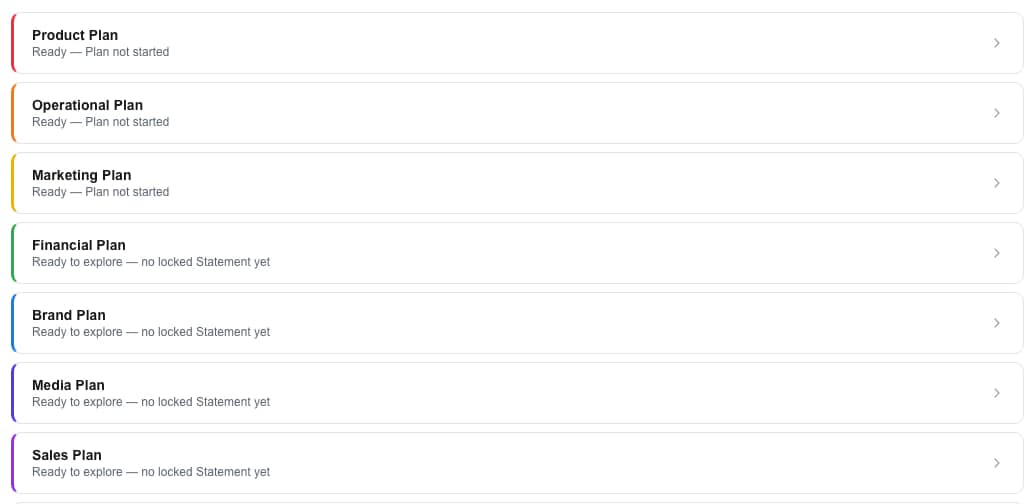
- Turn the functional strategy into a plan. Planning Station gives a function a plan whose Foundation brings in the strategy it serves, and whose Objectives each trace to the Parameters of Change they came from. Plans are available for Marketing, Brand, GTM, Operations and other functions, and each plan can connect to the others.
- Track delivery. The Monitoring Station follows the status, ownership and measures of what you decided to do.
Manual work throughout is free. AI suggestions are part of a subscription and are always drafts you accept, edit or reject. The methodology page explains the Strategic Decision Model, and Why StrategySOS explains why it exists.
Frequently asked questions
How do you turn business strategy into functional plans?
First decide what each function needs to change because of the business strategy: its implications, its Limitations, the possible changes, and the strategic choice it makes. Then build the plan from that choice, with objectives, initiatives, owners and measures that trace back to it.
What is the difference between functional strategy and a functional plan?
A functional strategy is the set of choices about what the function will change and what it will deprioritize. A functional plan is the operating document that turns those choices into objectives, initiatives, owners, budget and a roadmap. The strategy comes first.
Does every function need its own strategy?
No. A function needs a strategy when it faces meaningful strategic choices about what to change. If the work is largely about executing well, a plan may be enough.
Why shouldn't you just copy the business strategy into a functional plan?
Copying produces statements like "support the company's growth strategy," which say almost nothing. A functional plan has to show what the function is changing, what it is emphasizing and what it is deprioritizing.
How should cross-functional dependencies be handled?
Treat them as collaboration and planning context rather than part of the strategy. The strategic question is what each function needs to change. The planning question is who needs to work with whom to make it happen.
How do you check that a functional plan is aligned with the business strategy?
Ask whether you can explain which business choice the plan supports, what the function is changing because of it, and whether every major objective traces back to a strategic choice.